The Advanced Role of Composite Materials in Prosthetic Development: A Collaborative Effort Between the Medical Engineering Research Center and the Continuing Education Center at the University of Anbar
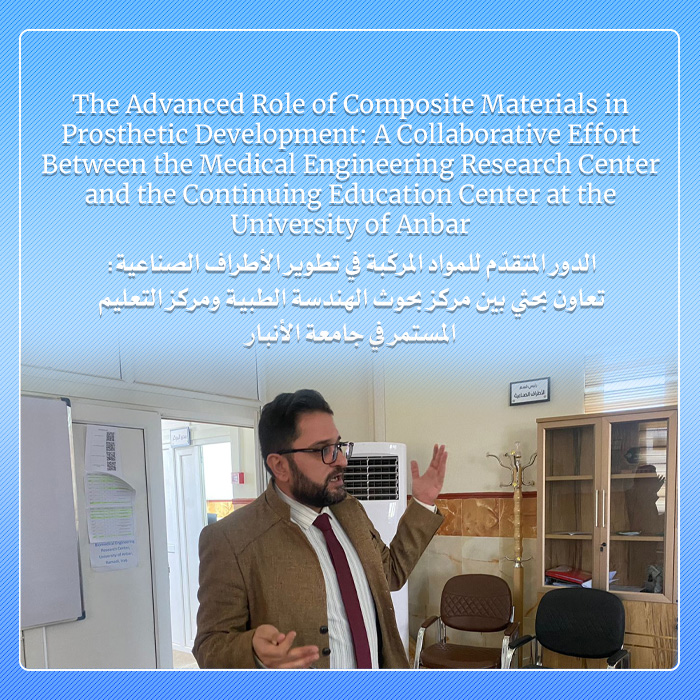
Within the framework of the joint collaboration between the Biomedical Engineering Research Center at the University of Anbar and the Center for Continuing Education, and under the direct supervision of the Center’s Director, Asst. Prof. Dr. Ali Amer Al-Rawi, Dr. Mohammed Jassim delivered a specialized scientific workshop addressing the vital role of composite materials in reducing weight and enhancing the efficiency of prosthetic limb design and manufacturing. This topic highlights the significance of composite materials in biomedical applications, as they represent an advanced option that directly contributes to improving the functional performance of prosthetic devices. These materials are characterized by their lightweight nature, high mechanical strength, resistance to fatigue, and adaptability to specific clinical requirements, making them ideal for developing prosthetic limbs that require a balance of durability, flexibility, and ease of movement. The Medical Engineering Research Center actively investigates and evaluates the engineering properties of composite materials compared to traditional materials such as metals and standard polymers. Research findings have demonstrated that the use of composite materials significantly reduces the overall weight of prosthetic limbs without compromising their stability or load-bearing capability. This weight reduction enhances user comfort, decreases muscular effort, and improves mobility—particularly for lower-limb prosthetics, where any additional weight has a substantial impact on gait and energy consumption. Furthermore, the Center adopts advanced manufacturing techniques utilizing carbon fibers, glass fibers, and high-performance resin matrices to achieve an optimal balance between structural strength and flexibility. Preliminary results indicate that incorporating these materials into prosthetic design leads to notable improvements in mechanical efficiency, enhanced load distribution, and increased resistance to repetitive stress, thereby extending the functional lifespan of the prosthetic device. In addition, the Center employs analytical methods and numerical simulation tools using advanced engineering software to assess the performance of composite materials under various motion, loading, and environmental conditions. This enables the development of innovative designs that meet functional and clinical needs in alignment with global trends in smart prosthetic technologies. Through these efforts, the Medical Engineering Research Center at the University of Anbar continues to strengthen its leading role in fostering innovation and advancing biomedical engineering solutions, leveraging advanced materials to improve the quality of life for patients and enhance the university’s standing in scientific research and medical engineering.


Topics may interest
Professor Dr. Yousif Ismail Al-Mashhadani Selected for “Scientist on the Platform” Initiative Highlighting His Contributions to Biomedical EngineeringMinisterial Committee Visits the Biomedical Engineering Research Center Regarding the Approval of Its Establishment
Biomedical Engineering Research Center Organizes Training Course on LabVIEW Interface with Arduino Within the activities of the Continuing Education Center
Electrical Engineering Students at the University of Anbar Achieve Third Place with a Smart Water Quality Monitoring System
Honoring Prof. Dr. Yousif Ismail Al-Mashhadani with the Medal of Creativity and Innovation at the University of Anbar
Central Organization for Standardization and Quality Control Celebrates World Intellectual Property Day with Academic and Official Attendance
A Distinguished Scientific Achievement: Biomedical Engineering Research Center at the University of Anbar Indexed in Scopus
The Biomedical Engineering Research Center Receives a Ministerial Committee from Ministry of Higher Education and Scientific Research